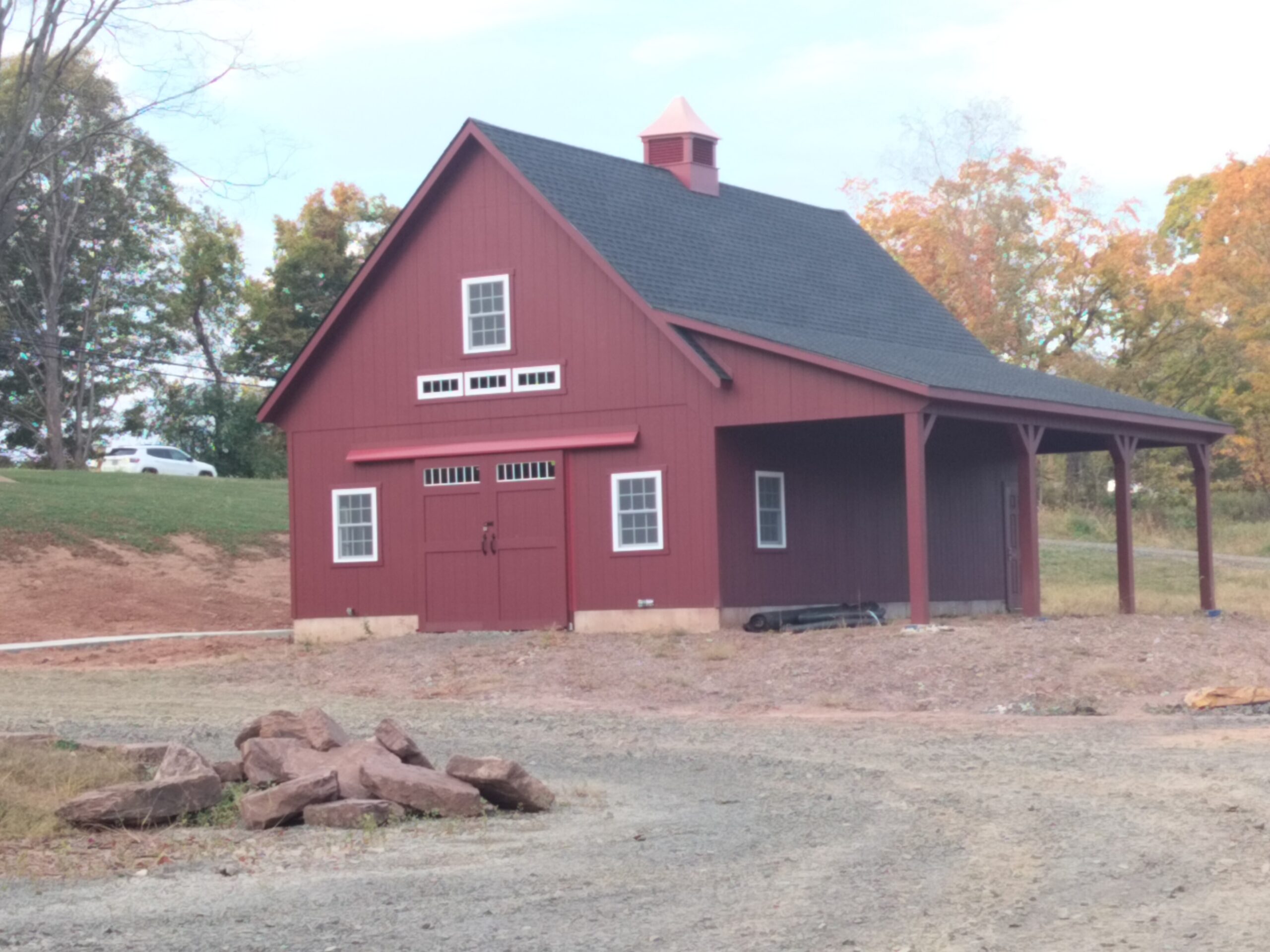
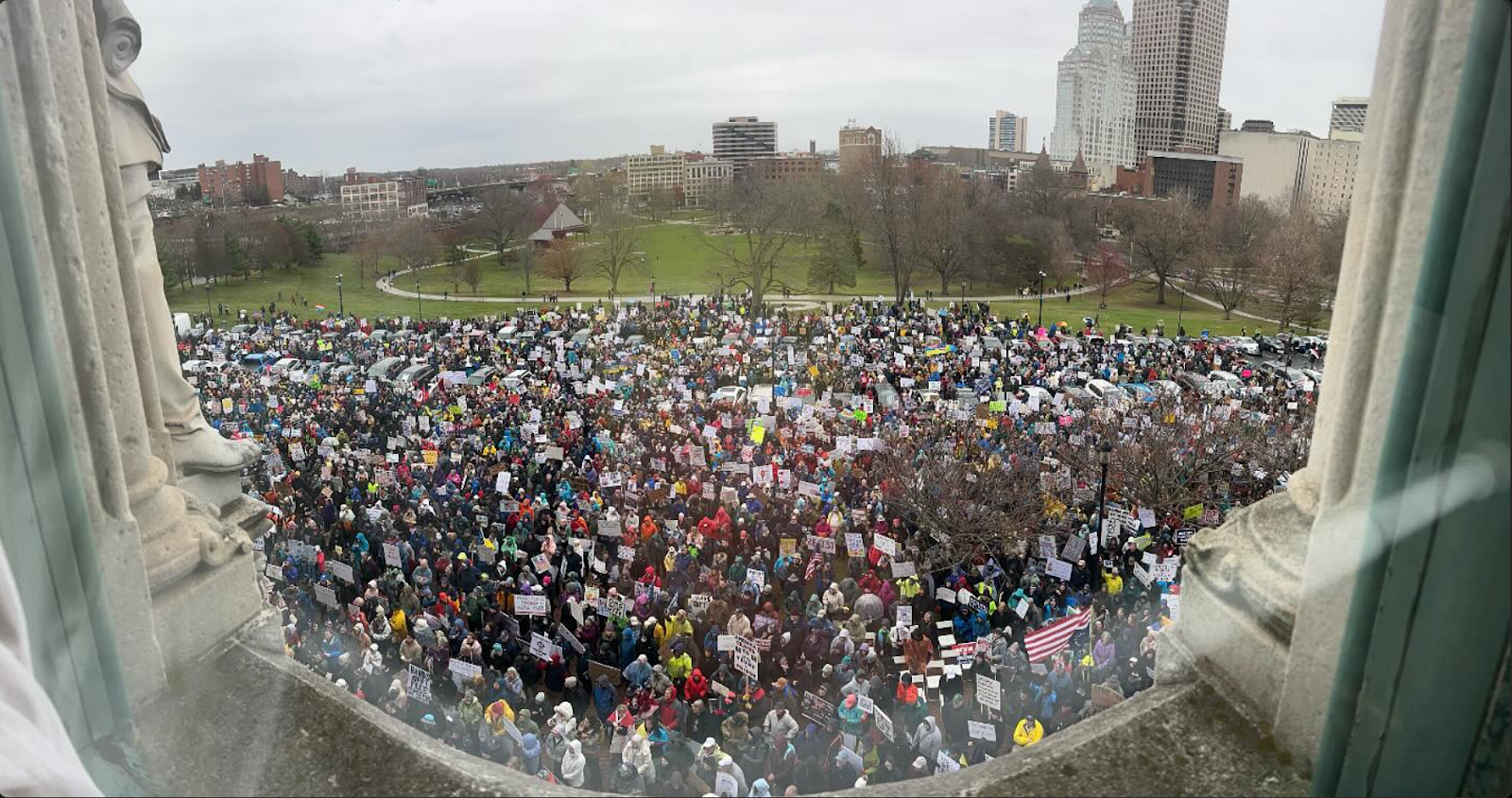
On April 5th, my family and I attended a “Hands Off” rally in Hartford, one of thousands organized simultaneously around the country. Although it was a drizzly day, the crowd of several thousand people before the capitol was upbeat and excited. We cheered for speakers who came to the podium, chanted slogans, and basked in the experience of being in a large social gathering. We, along with many other Rocky Hill Democrats, were gathered here to protest against the Trump presidency and its sweeping efforts to dismantle the federal government and oppress dissenting voices.
For my wife Mara and me, the moment also came with a certain sense of déjà vu. We had been here before. Here we were, a few months into a Trump presidency. The country had been thrown off the rails, and people were taking to the streets. When Trump was first inaugurated we were living just outside Washington, D.C. We spent a lot of our evenings in the first year of our marriage participating in rallies. Our son attended a lot of protests before his first birthday; today, he brought a sign he made on his own.
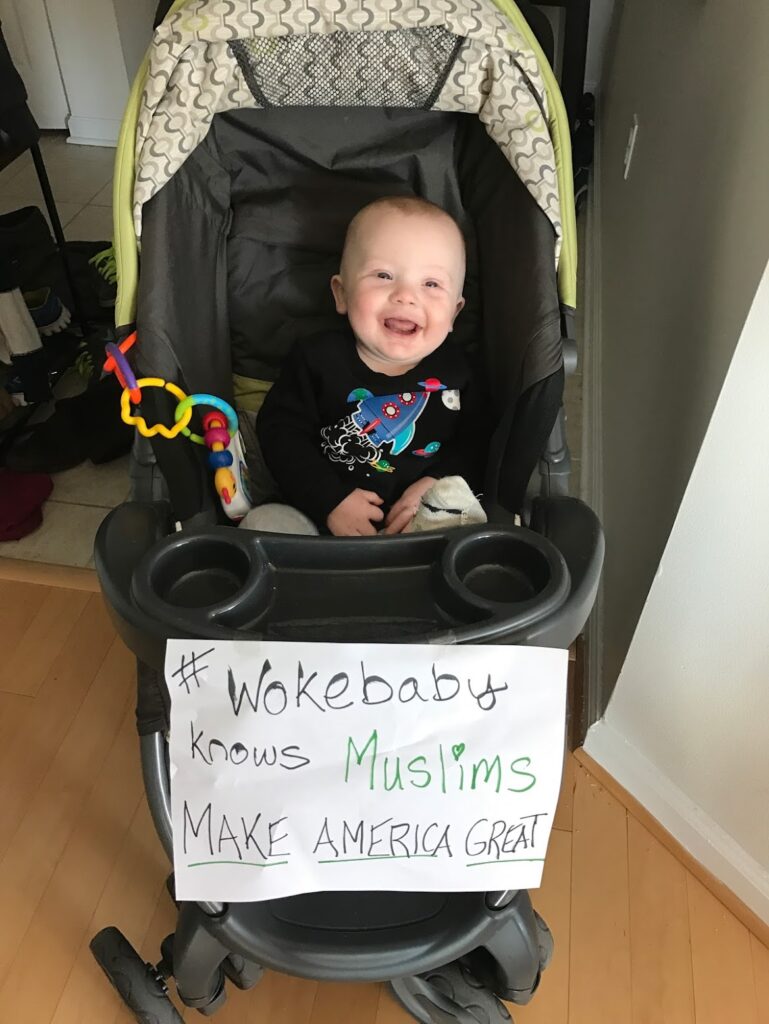
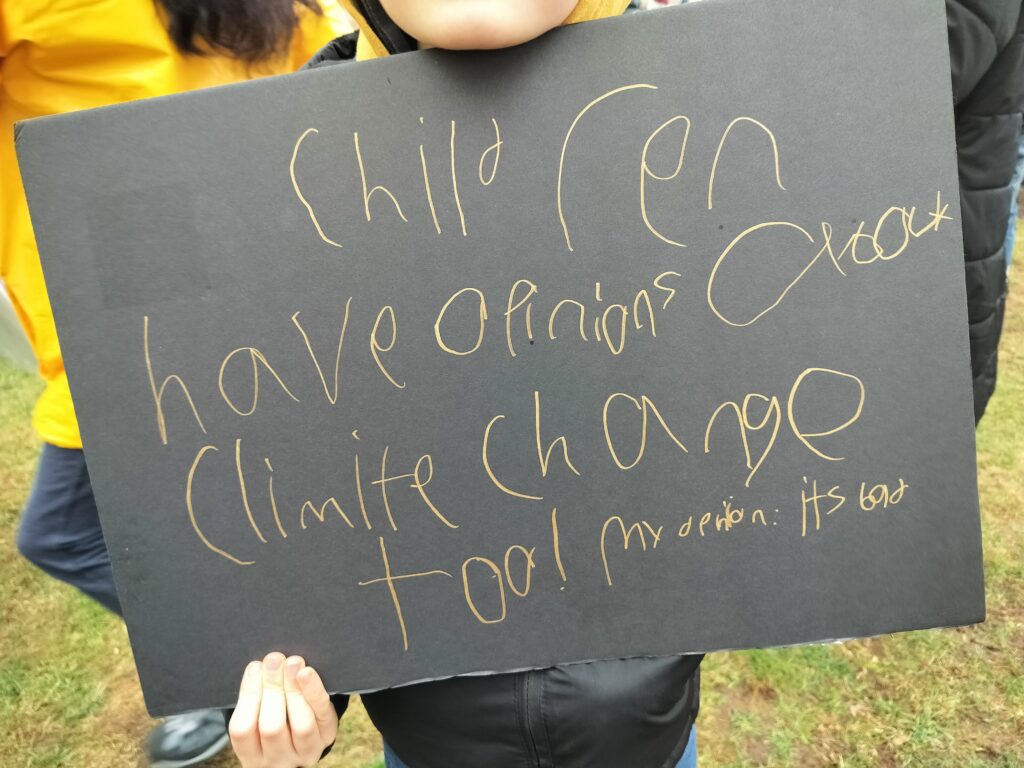
Our child in 2017 and 2025
It is fair to say that today Mara and I don’t view protests, even very large ones, as panaceas for our country’s ills. After all, much was made of the fact that the Women’s March of 2017 (which Mara attended) was the largest protest in U.S. history. Despite this and other coordinated marches, strikes, and protests, the Trump presidency ran roughshod over many of the people and issues we held dear. It is clear that a single mass mobilization, even a very large one, usually doesn’t prevent bad people from exercising their power.
But we did attend the rally in Hartford, as did hundreds of thousands of people across the country. Why? What value do protests have?
Historically, a large protest was seen as a major flex for a movement. Pulling off a large gathering in multiple locations was a demonstration of the strength of a movement, a measure not only of the number of bodies it commanded but logistical and organizational power. The 1963 March on Washington (which, by the way, was organized in just eight weeks before the Internet was a thing) was a feat that could not have been accomplished by a movement with less administrative talent. The march was galvanizing force in America and put extreme pressure on the presidency to pass the Civil Rights Act. By contrast, in the era of social media it has become easier to organize protests. The famous protests that resulted in the downfall of the Egyptian dictator Hosni Mubarak in 2011 were organized through Twitter and Facebook by an activist living in another country altogether. And yet, in both instances, protests helped to bring dramatic change about.
I love these examples, but they raise the bar a bit high. If participating in a protest doesn’t stop Congress or President Trump from taking action, it should not be considered a failure. Even without toppling a government or enabling critical legislation, protests have value in and of themselves.
Protests build community and identity
For about six months after the 2024 election, my family had an unwelcome visitor. We were one of those “sign houses” that had a political sign up for many Democrats running for state and political office. Added to the mix was a black and white placard saying “Hate has no home here” which was supplied by the Rocky Hill Community Church (RHCC). We’ve kept this sign up ever since we heard about neo-nazi groups trying to organize in our town, and it stayed after the election was over. But its presence must have irritated a Trump supporter, because we started to get house calls.
Once every two or three days, a car would drive by, and the driver would shout out to our house, “Haters live here, haters!” or, more typically, “Trump!”. On special occasions, he would get more creative, and give us countdowns to events like Trump’s inauguration. It was harmless, and honestly a bit sad, but combined with national news it began to feel very disheartening. Trump had won the popular vote! The famous “blue wall” had shattered. We were inundated with news stories about how an emboldened far right had seized power and was wielding it to dismantle our country. Perhaps our visitor represented the actual mood of the country, and I was the outlier.
Social scientists have a term, “pluralistic ignorance”, which describes the feeling of being an isolated minority even when there are many people who agree with you. Protests are one method we have for breaking down that sense of isolation. In a delightful book called Twitter and Teargas, Zeynep Tufekci says that it is “unsurprising, though striking, that community building may be among the most important functions that a protest march or a persistent occupation serves.”
When you are surrounded by hundreds or thousands of people who are chanting together, cheering for the same speaker, and waving signs with aligned messages, you remember that you are not in fact alone, and there is a large community of folks who want to work to make the world better. It is tremendously encouraging. When I asked my own networks why they participated in the rally, the responses overwhelmingly were that they found hope in the sense of community.
“In these [protests] we are building towards an unstoppable force,” said New Britain progressive, Chris Waters. “Right now a small minority is attempting to overthrow our country. Joining these protests shows that there are far more of us and that their actions won’t go unopposed.”
I’ve been joining the weekly rallies organized by the Rocky Hill Congregational Church on our main street. For the past month, we’ve gathered on Main Street and waved signs in support of Black, immigrant, and LGBTQ+ communities. It’s a small gathering, usually less than twenty people, but as we wave our signs there have been frequent honks and waves from drivers passing by. It has been a remarkable reminder of how many people in Rocky Hill don’t stand for what is happening in the country.
By a pleasant coincidence, since I attended the first RHCC rally in Rocky Hill our Trump visitor has yet to make an appearance.
Protests are an opportunity for self expression
Within crowds there is a satisfying space for people to exist as individuals. While attending the Hartford rally I saw people wielding hundreds of different hand-made signs. Each sign reflected the issues and concerns of its maker. In form, they were printed, painted, written in marker, and magazine cut-outs. People clearly had dedicated a lot of time and effort to these placards which likely would not endure beyond a single rainy-day protest.
Again, from Zeynep Tufekci: “We wish to express ourselves, and protests in today’s world often intermingle expressive and instrumental aims…Protesters want the world to change and may be demanding a set of policies or attention to their issues. But protests are also locations of self-expression and communities of belonging and mutual altruism. Protests have always had a strong expressive side, appealing to people’s sense of agency.”
Even though the signs themselves might disappear into the recycle bin, many find identity and creative expression in the act of participating in a protest. That is valuable in and of itself. If that creative expression is restorative, or helps us to marshal the energy to continue to organize, so much the better.
And yes, protests can shape the world
I have focused mostly on the impact of demonstrations on communities and individuals, but protests do play a broader political function as well. The most obvious and visible outcome of a demonstration is that people in power change their position, or lose their authority. More subtle than this, however, is the way that a successful protest can shift public opinion or policy.
A recent study by U.K.-based Social Change Lab argues that some protests, especially large and well-organized ones, can have a meaningful impact on public opinion, public policy, and public discourse. The phenomenon is measurable enough that they recommended philanthropists interested in funding causes invest in protests as a way to achieve the change they were looking for.

Public opinion on “the most important issues facing the country” in the U.K. measurably changed with protest events. Source: YouGov
An illustration from the political right: After Barack Obama’s election in 2008 there was a dramatic mobilization in the form of the Tea Party Movement: a conservative wave focused on government spending. On April 15, 2009, a series of Tea Party protests mobilized in the U.S. As often happens, in some parts of the country it rained, which tends to depress turnout. This made for a fascinating case study, in which political scientists were able to measure the impact of protest size on the upcoming elections. It turns out that larger political protests facilitated the strengthening of the conservative movement and led to more Republican votes in the 2010 midterm elections. Perhaps this is something that will inspire the political left.
So, join a protest
All of this is to say that protests play an important role in our political process. But they aren’t the only way to get involved. I spoke with Kerry Wood, Rocky Hill’s representative in the State Legislature, and her big takeaway from the day that it should be a call to action for people to get engaged.
“Participating in Democracy at any level is the value, what I’m seeing and hearing daily are people raising their voices where they can. I have been to dozens of fundraisers, rallies, press conferences, and networking events in the past week. Every event has an energy level that I haven’t seen in years. What we gain from these events is a renewed sense of purpose, community, and support structure. We can’t sit back, in any way people know how, their participation in the fight for Democracy is welcomed and encouraged.”
If you participated in a protest yesterday and are fired up for change, use that energy to join an organization. Obligatory plug: I joined my town’s Democratic Committee and I’ve found that to be a great outlet for my activism energy. But find what works for you! Maybe you want to support the local chapters of the ALCU, or find another organization that focuses on your particular interest area: climate, housing, etc. Join a local progressive group. Just get engaged, and the rest will follow.