Author: Zach van Luling

  • Rocky Hill Cannot Keep Deferring Its Future

    Rocky Hill Cannot Keep Deferring Its Future

    Opinion piece: this article represents the perspective of the author.

    After years of deferred obligations, strained services, and short-term thinking, the real question is whether we continue managing decline in slow motion or begin restoring the capacity our town needs to succeed.

    A municipal budget is the most serious vote a Town Council takes. It is where values, obligations, constraints, and consequences all meet. It affects the tax bill residents receive at home. It affects the services families rely on. It affects the schools that shape our children’s futures. It affects whether we govern for the next news cycle or for the long-term stability of Rocky Hill.

    The Cost of Carrying Too Much for Too Long

    When many of us were elected last November, we knew this budget process would be difficult. What I found after taking office was a town and school system that are succeeding in large part because the people inside them have been carrying more than they should have been asked to carry. Teachers, administrators, town staff, public safety personnel, library staff, senior center staff, human services staff, and many others have been stretching their roles through dedication, resilience, resourcefulness, and endurance.

    That speaks well of them. It does not speak well of the governing pattern that made that level of strain necessary.

    A Familiar, But Broken Budget Pattern

    For too long, Rocky Hill was caught in a familiar routine: short-term budget relief, politically manageable cuts, and delayed obligations pushed into the future. The problem is that the future eventually arrives. Deferred pension obligations, deferred staffing needs, deferred investments in services, deferred infrastructure, and deferred capacity in our schools and town operations eventually become more expensive, more urgent, and more dangerous.

    That is the doorstep Rocky Hill is standing on now.

    What This Budget Begins to Correct

    The budget we approved last night begins the work of correcting that trajectory. It increases part-time support at the Senior Center, the Library, and Human Services. These are resident-facing services. They affect seniors, families, children, and residents who need the town to function with competence and care.

    It increases funding for Fire Department training, because public safety cannot be treated as a place where we hope everything works out. Preparedness costs money. Lack of preparedness costs more.

    It strengthens our economic development capacity by upgrading that position to full-time and adding outside grant-writing support. That is exactly the kind of forward-looking investment Rocky Hill needs. We should not simply wait for opportunity to find us. We should be organized enough, professional enough, and ambitious enough to pursue it.

    Protecting the Schools That Define Our Town

    On education, this budget maintains the bulk of the Board of Education operating budget, with only a modest adjustment of $250,000 that can hopefully be targeted toward central office. At the same time, it funds additional student-level support in meaningful areas: mental health, social work, class size reduction, and special education. Those are not ornamental additions. They go directly to the experience of students and the capacity of educators to do their jobs well.

    Rocky Hill’s schools are central to our town’s reputation. They are part of why families want to live here. They are part of why our real estate market and property values remain strong. They are part of the civic inheritance we are responsible for protecting.

    Discipline and Vision Can Coexist

    This budget also reflects discipline. Through targeted adjustments across the whole budget, we found more than $1.7 million in savings. That matters. It shows that this was not simply a matter of saying yes to everything. We made real reductions. We scrutinized the numbers. We worked through the budget in detail.

    That is the difference in the governing approach residents are seeing now. The answer is not to spend without discipline, and it is not to cut without regard for consequence. The answer is to look honestly at the town’s real obligations, make targeted adjustments where they are justified, and still invest in the capacity Rocky Hill needs five and ten years from now.

    Through extraordinary coordination between our state delegation and leadership here in town, we also secured substantial state support that helps lessen the pain for taxpayers. That was not a gimmick. It was real, hard-fought relief, and it is going a meaningful distance in this budget process.

    Affordability Requires More Than Avoidance

    I understand why people are frustrated. I understand why any increase feels heavy. Nobody should pretend this is easy. But there is also a cost to inaction. There is a cost to pretending that the same familiar routine can carry us indefinitely. There is a cost to exploiting the dedication of good people until exhaustion becomes an operating model.

    That is not responsible government. It is the quiet accumulation of risk.

    The question before Rocky Hill last night was whether we would keep managing decline in slow motion, or whether we would begin restoring the capacity this town needs to succeed. This budget is not perfect. No budget is. But it is serious. It is targeted. It is more precise than the budget habits that helped create the hole we are now trying to climb out of.

    Last night, the alternative offered to this budget reflected the same familiar routine that helped bring us to this point: cut what is politically easiest, postpone what is structurally necessary, and call the delay fiscal discipline. That approach may sound restrained in the moment, but it does not erase the underlying need. It moves the consequence to a later year, when it is usually more expensive, more disruptive, and harder to reverse.

    I also want residents to know that the elected officials who worked through this budget put enormous time, energy, and ingenuity into the process. This was not casual. It was not automatic. It was the product of long meetings, difficult conversations, detailed review, and a sincere effort to balance affordability with responsibility.

    A responsible budget does not only ask what is politically easiest in a given year. It asks what happens if we keep delaying the same needs, keep stretching the same people, keep hoping that resilience can substitute for investment, and keep postponing the future capacity of the town.

    A Necessary Corrective Step

    I believe this budget is a necessary corrective step. It protects core services. It invests in students. It supports seniors and families. It strengthens public safety. It gives economic development the tools to compete. It begins to treat the future as something we are obligated to plan for, rather than something we can keep putting off.

    For those reasons, I voted to support this budget.

    But more than that, I voted to end a pattern.

    Rocky Hill cannot keep calling deferred obligations “savings.” We cannot keep asking excellent employees to compensate for inadequate capacity, or keep asking strong schools to remain strong while the supports beneath them are gradually thinned.

    We cannot preserve affordability by allowing the foundations of town government to weaken quietly beneath our feet.

    Real fiscal responsibility requires more than restraint. It requires foresight. It requires the discipline to distinguish a cut from a consequence, and a savings from a cost we have merely postponed.

    There is no more road left for Rocky Hill to kick the can down.

    At this point, repeating the old familiar pattern would not preserve stability. It would consume it. The consequences would not remain theoretical for long. They would show up in strained classrooms, thinner services, deferred repairs, weakened capacity, and costs that become harder to control precisely because we waited too long to face them.

    Governing With Vision

    Rocky Hill is a strong town because generations before us made serious decisions that gave us good schools, safe neighborhoods, reliable services, and a community worth choosing. In recent years, too much of that long-term perspective was displaced by short-term budget habits that deflected, dismissed, and delayed the realities in front of us. Our obligation now is to make decisions worthy of that inheritance.

    That requires vision. Not vision as a slogan, and not vision as a campaign word, but the practical discipline to see the town as it will exist years from now if we either meet our obligations or avoid them. Governing with vision means understanding that the easiest cut in a budget meeting can become the most expensive problem tomorrow. It means caring enough about affordability to protect the services, schools, infrastructure, and public safety systems that make Rocky Hill worth investing in at all.

    Last night’s vote was a choice between continuing the familiar pattern of deferral, and beginning the harder work of repair. It was a vote to protect what works, mend what has been excessively strained, and plan for the town we intend to remain.
  • Closing Argument: The Case for Change in Rocky Hill

    Closing Argument: The Case for Change in Rocky Hill

    By Zach van Luling, Candidate for Town Council

    Rocky Hill is at a decision point.

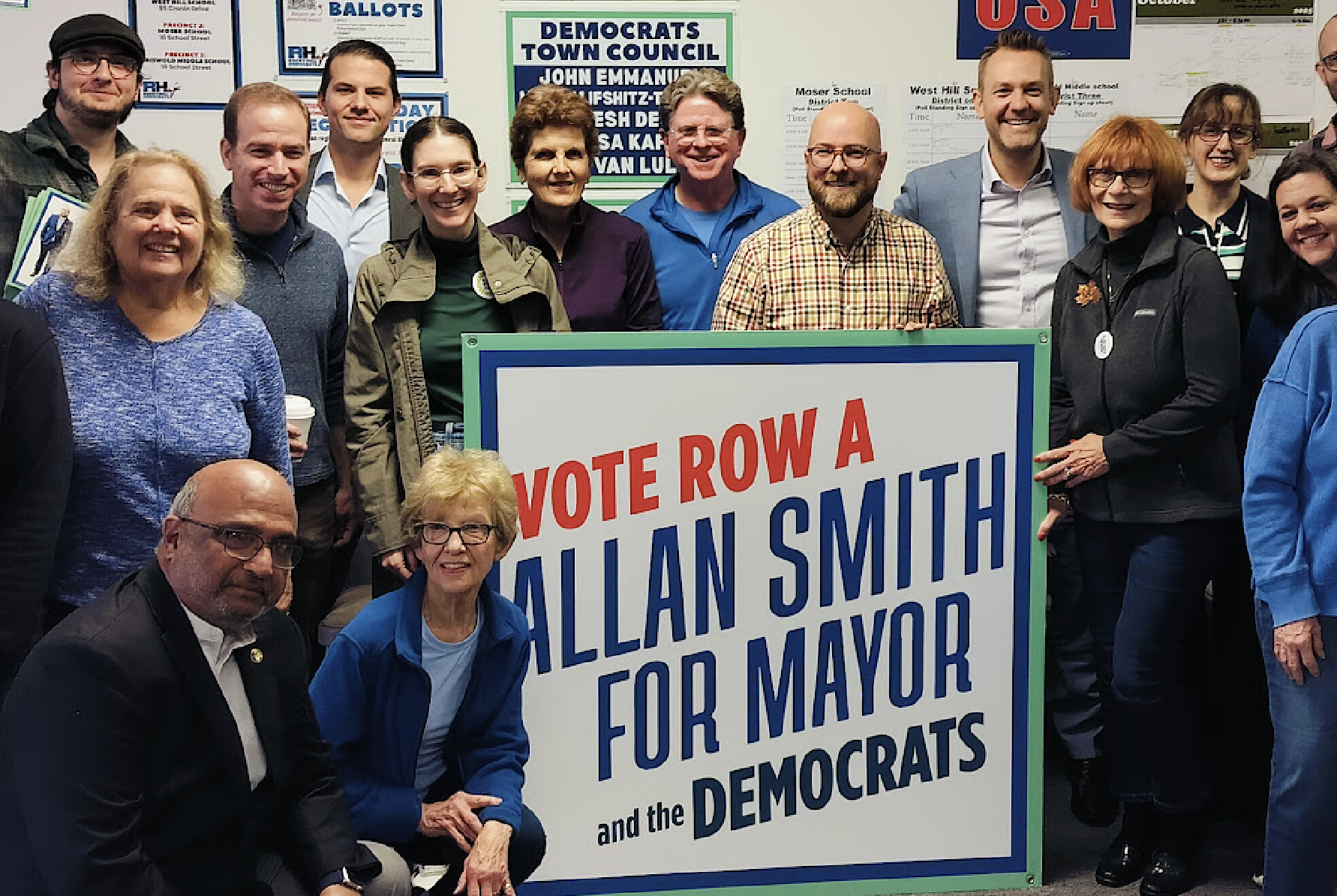
    I am running for Town Council, and I am asking you to support the entire Democratic slate, led by Allan Smith for Mayor, because what happens in this election will decide what kind of town we are going to be for the next several years.

    This is personal for me. My wife and I chose Rocky Hill because we wanted to raise our daughter in a place that felt steady, safe, and proud of itself. We are putting down roots here for life. I do not take that lightly. When I talk about schools, public safety, taxes, sidewalks, and basic services, I am not talking in theory. I am talking about the town I am counting on to raise my child, and the town that seniors here are counting on to stay livable.

    You have not seen me posting constantly on Facebook all campaign season because I have been spending my time in person with the people who live here. Since June I have been knocking doors in Rocky Hill almost every single day, with only a couple of exceptions. That is several thousand doors across nearly every neighborhood in town. I have had long conversations on porches and in driveways with parents who are worried about class sizes, seniors who are worried about the tax bill and the next one after that, and neighbors who are worried about public safety in a very basic, human way. Speeding through neighborhoods. Blown stop signs. Distracted drivers. People asking if their kids can safely walk to a friend’s house.

    I believe that if you want to make decisions on behalf of residents, you owe them the respect of listening before you talk.

    Here is what I am hearing, and here is what it tells me about where we are as a town.

    Rocky Hill residents are worried

    For a long time, Rocky Hill had a real point of pride. People here could say our mill rate was competitive and our services were strong. That was not just a slogan. It meant you could feel the value of what you paid for. It meant you could tell people in surrounding towns, we run things well here.

    Lately that is slipping. We watched services get cut. We watched support for our schools get stretched. We watched class sizes go up. We watched the volunteer fire department have its training budget and equipment funding cut below even what the Town Manager recommended, while the department is actively rebuilding its ranks with newer, younger firefighters who need training and gear to do the job safely. We watched the town cut from the library, to the point where the library today is running with fewer total staff hours than it had years ago, and is expected to somehow deliver more programs anyway. We watched the Board of Education lose the ability to fund a world language program at Moser and to hold down early grade class sizes at the levels research tells us are best for literacy.

    And after all of that, after cuts to core services, after cuts to the schools, after telling departments to make do with less, the mill rate still went up.

    If you are a parent of a second grader in a class size of 23 or a fourth grader in a class of 24 students, you feel that. If you are a senior on a fixed income, you feel that. If you are a firefighter’s parent watching your kid answer calls in the middle of dinner, you feel that. If you are a librarian being told to provide services to more than 100,000 annual visits with fewer staff hours than you had in 2018, you feel that.

    This is not about slogans. This is about priorities and planning.

    Better Schools

    Let us talk about schools clearly, because a lot of political language has been thrown around. The sitting Mayor has claimed our schools were fully funded. At the same time, the Board of Education was forced to make painful cuts. The Board did not fill needed positions to reduce class size. The Board could not fund a world language program. The Board had to absorb rising insurance costs and negotiated salary increases in order to stay competitive in a statewide teacher shortage. Those are not luxuries. Those are mandatory, real-world costs, the same way your mortgage and insurance and car payment are mandatory.

    Rocky Hill already ranks among the lowest districts in our comparison group for per-pupil spending. Yet our academic performance is strong. That should tell you that our educators and administrators are working incredibly hard with limited resources. That is not evidence that we can keep cutting. That is evidence that we are at the line.

    The Rocky Hill Teachers Association, which represents the teachers and education professionals who actually work with our kids every day, endorsed Allan Smith for Mayor and the entire Democratic slate for Town Council and Board of Education. I want you to sit with that for a moment. The people in the classrooms have said, these are the people who will listen to their concerns, fund what is necessary, insist on transparency, and actually collaborate. They did not give that endorsement lightly.

    Better Public Safety

    Public safety has also been treated as if it is negotiable. It is not. When I talk with residents, they are not asking for speeches. They are asking for safe streets in front of their houses. They are asking for drivers to slow down. They are asking for the town to stop pretending that blown stop signs, distracted driving, and 40 miles per hour on a residential street are something we just have to live with. A serious town government should be willing to use every responsible tool we have, including technology and cameras where appropriate, to calm traffic and protect people. At the same time, we should never be cutting training and equipment budgets for the volunteer firefighters who are the ones physically showing up when there is a crash, a fire, or a medical emergency at two in the morning. You cannot claim to support public safety and then slash the resources that keep first responders alive.

    Better Growth

    Let us talk about development. You are going to hear a lot of talk about how one high profile development in town will be one of our biggest taxpayers “in just a few short years.” Here is the truth. The developer at Kelson Row is already collecting rent, families are already living there, kids are already using our schools, but meaningful tax payments from that project do not begin until well into the next decade. The tax abatement that was granted was, in my view, overly generous, and it pushed real costs onto residents who saw their own assessments and taxes jump after revaluation. Every Democrat on the Council voted no on that deal. The Republican majority voted yes.

    This is why “better growth” is not just a talking point for us. It is the standard. Good growth should strengthen the tax base, not quietly shift costs to everyone else for ten years. Any deal made with a developer on behalf of the people of Rocky Hill should include real, public performance milestones and clawbacks if promises are not kept. You should never have to guess whether a deal is worth it. You should be able to look it up in plain English.

    Better Leadership

    Transparency is not a buzzword, and I want to be very clear about what we mean by it, because our opponents use the same word and mean something different. The current Republican majority has a habit of conducting town business quietly, with little collaboration or even basic communication across the aisle. By the time most residents hear about an issue, it already feels decided. That shuts people out of their own local government.

    A Democratic majority under Allan Smith would bring that process back into the open. That means posting timelines and maps for paving, sidewalks, and drainage work so you can see when your street is scheduled and who is responsible. That means real updates on public safety, permits, and capital projects in language people can actually read. It means expecting the school liaison to show up and report, and expecting councilors to actually attend public meetings and answer for decisions. It means that meetings themselves will be more useful to the public, with clear minutes and recordings shared using basic modern tools so people can follow what happened without having to dig.

    It also means access. Allan and our team plan to bring back regular office hours for residents, where you can sit down face to face with your local leadership, ask a question, and get a direct answer. We will hold recurring meet and greet sessions in town, not just before elections, and not just for a photo. The goal is that you do not have to chase us. We will be available.

    That is what leadership looks like. Respect for taxpayers. Respect for teachers. Respect for first responders. Respect for families and seniors. Respect for the people who built this town and the kids who will inherit it.

    The Case for Change in Rocky Hill

    We are not promising fantasy. We are promising priorities.

    Fund the core. Protect the essentials. Plan for the future like adults. Tell the truth in public.

    That is the choice in front of Rocky Hill. We can keep doing what we have been doing, which is cutting into the things that actually make a town livable while telling people they should feel lucky, or we can change course.

    If you want a Town Council and a Mayor who will fight for safe neighborhoods, honest budgeting, stable schools, real transparency, responsible growth, and real partnership with our delegation at the state level, then I am asking you to vote Row A for the Democratic slate.

    Early Voting is happening at the Rocky Hill Senior and Community Center every day this week through Sunday from 10 a.m. to 6 p.m. Election Day is next Tuesday, November 4, and polls will be open from 6 a.m. to 8 p.m.

    My name is Zach van Luling. I am running for Town Council. I am asking for your vote, and I am asking you to vote for Allan Smith for Mayor and the entire Democratic slate. We are a group of competent, dedicated professionals that will restore trust in the good faith governance of our town.

    Choose a Rocky Hill we can be proud to hand to our kids.

    Choose a Rocky Hill where seniors are respected.

    Choose a Rocky Hill that works for the people who actually live here.

    This year, vote for Allan Smith for Mayor and the Democrats on Row A for better growth, better schools, and better leadership.

    Your neighbor,

    Zach van Luling
    Candidate for Town Council

    —–

    Visit www.rockyhilldems.org/vote/ to for information on:

    • Confirming registration and polling location
    • Early and Election Day in-person voting
    • A sample of the 2025 ballot

    If you need a ride to the polls on Election Day or during Early Voting, please call us at (860) 798-7153