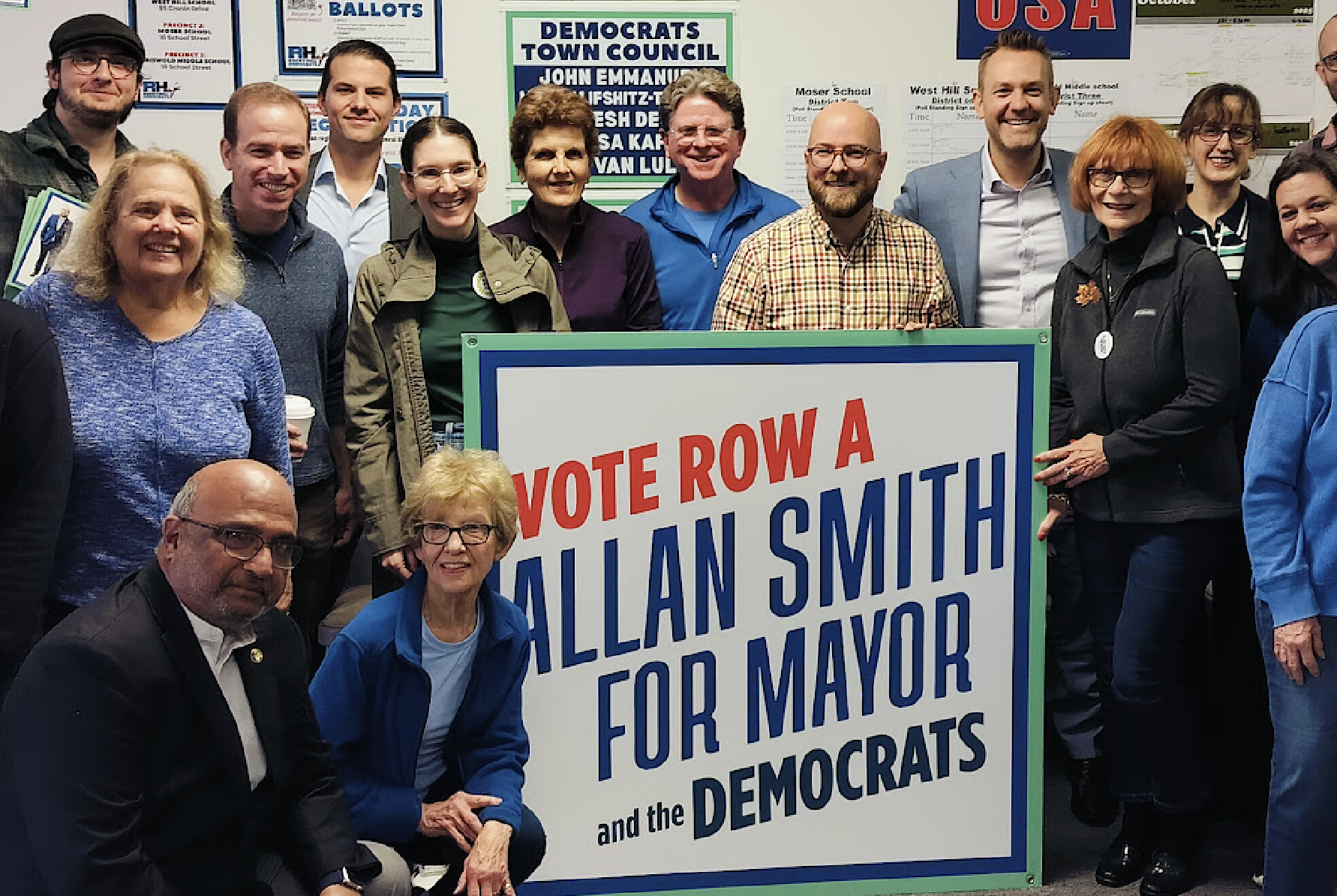

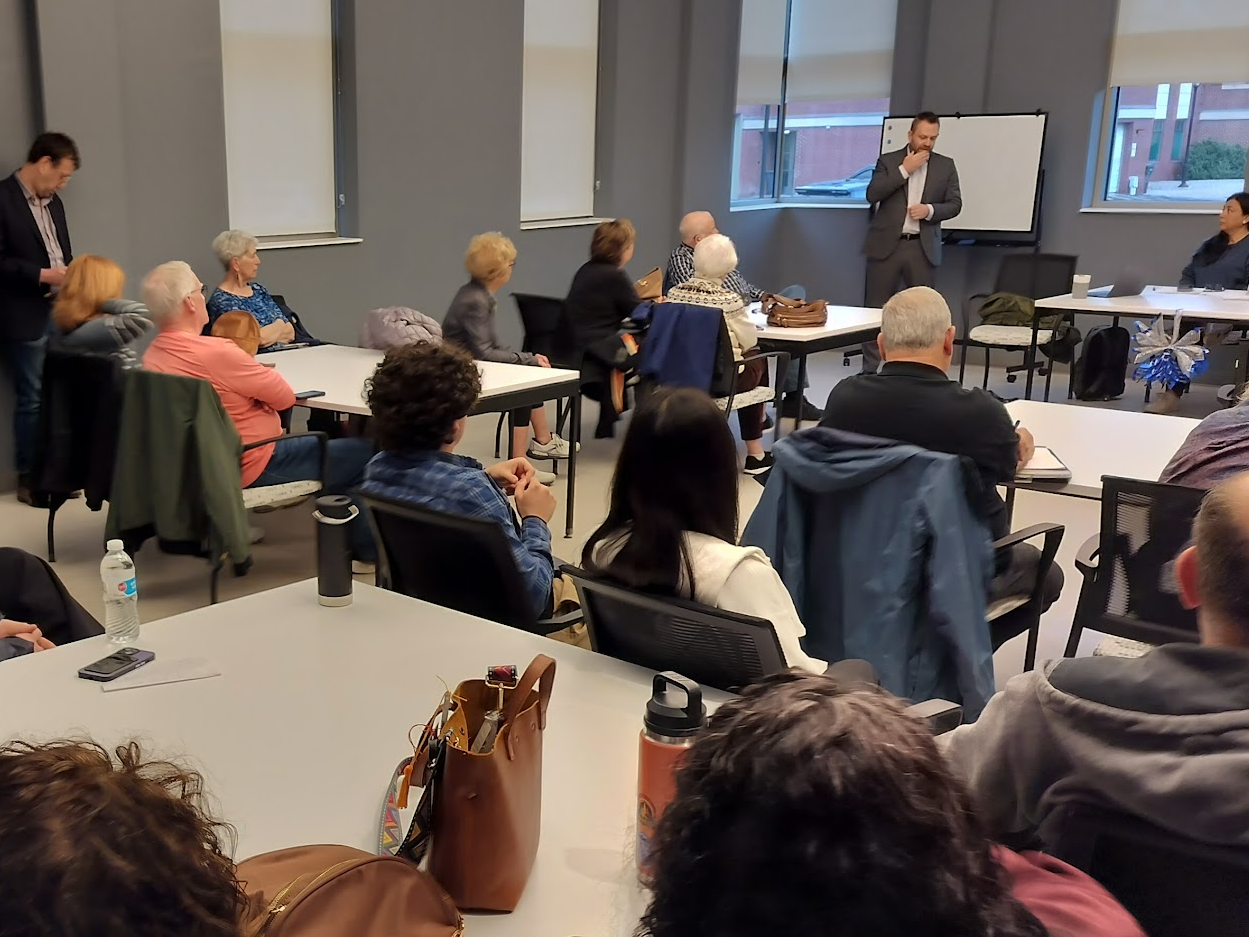
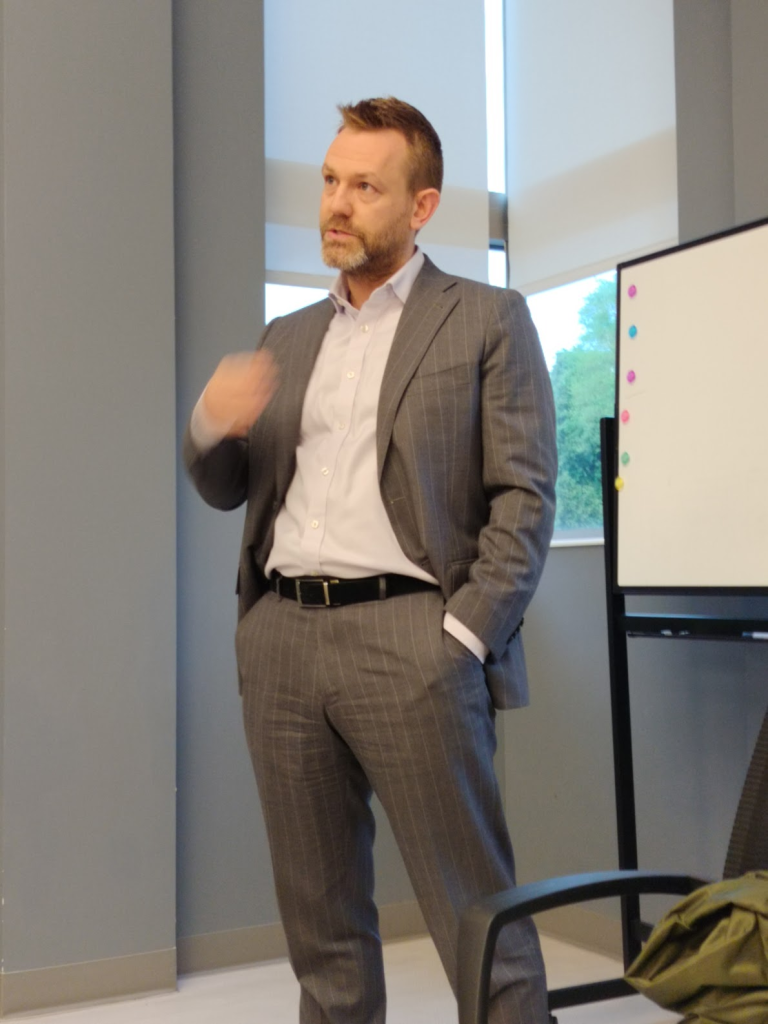
The following remarks were made by Gubernatorial Candidate Josh Elliott at the May 14 Democratic Town Committee meeting. They have been lightly edited for clarity.
I’m Josh Elliot, Democrat, running for governor. This is thankfully the last DTC I hit before the convention. You are number 135.
I started in July of last year. It was just me, and over the course of time, we are now the best fundraising campaign that the state has seen for a gubernatorial election, we have raised about $280,000, just over $50,000 to go.
I’m going to tell you a little bit about who I am. I’ll tell you why I’m running, and if you have questions, I’m happy to answer them.
So I grew up in the shoreline, I grew up in Guilford, and I ended up going to school at Ithaca, where I graduated with a degree in sociology, and the emphasis was on criminal justice reform. Graduated, lived in Ithaca for a couple years, and a friend of mine who had been working on the Hillary Clinton campaign comes up, and I had never been engaged in politics before, and he tells me about the work, and I started feeling like this might be something that I want to do, and he’s going to move down to Virginia, and I decided to go down there for a year to work on a political campaign.
I didn’t grow up in a political household. It was my mother and myself, and for her, life was really point A to point B. In fact, she opened a little business in Hampden that I actually co own with her now a little natural food store. And it was only during the college years that I had an inkling that I was probably a Democrat to the years of hanging chad and the Iraq War and the Florida decision. And so when Obama had announced, that’s when I started becoming more interested and engaged.
So okay, so I moved down to Virginia, worked on this campaign, and we get crushed two to one. Move back to Connecticut, ready to rid myself of politics forever. Moved to Hamden because that’s where the family business is. And I also go to Quinnipiac Law School. Graduate become an attorney. Don’t end up practicing, because I immediately open up my own little business, a little natural food store in Sheldon. I run that for a couple years, and then I start getting involved in politics again.
I graduated in 2006 which means within a couple years, you have this massive market crash, and I’m watching the way that our big banks are getting bailed out by taxpayer dollars. Couple years after that, you have Citizens United, which goes to the Supreme Court, and now, all of a sudden, unlimited dark money will begin to flow through our political system. And it’s at these three years, within these three years, that my political orientation really becomes set. I’m an economic populist, and so I’ve been following the career of Elizabeth Warren, hoping that she would run that year in 2015 she didn’t this person, Bernie Sanders frame. I didn’t know anything about it, but he was talking about the growing and massive divide between the ultra wealthy and everybody else, talking about building out a middle class the way we used to do in the middle of the 20th century, talking about the pervasive nature of dark money in politics and how it’s affected our systems.
I want to get involved this campaign because of the message it was putting out there. So I’m knocking doors and making calls here in Connecticut, Massachusetts, New Hampshire, and then, of course, that campaign ends, and that’s the point that I’m approached by the Working Families Party, and they asked me if I went for office, but I seen that I was represented by Democrats now the board, so I said, there’s no place for me. They wanted me to primary, and because they felt that my positions on increasing the minimum wage on paid family medical leave were a good fit, because I’m a small business owner, and they wanted me to challenge. Ultimately, I said, Okay.
This gentleman decided he was going to run for his ninth term. I announced that I was going to run two weeks after that, and two weeks after that, he decided to instead retire and go and not run for re election. For those of you in this room that do not know my origin story, the person who I pushed into early retirement was the sitting Speaker of the House, Brendan Sharkey. That’s how I got my political start.
Naturally, the Democratic town committee was very unhappy with me. I lost my convention 18 to three. I had three months to prove myself to the rest of the town, and with the support of labor and the support of the people that I met the prior year on that campaign, we ended up winning against somebody who had been involved in local politics for 20 years. It actually years. He’d actually been acting mayor at one point for nine months, by a measure of 6040, after going from a total unknown.
Fast forward 10 years. In my first term, I started the Progressive Caucus after 20 years of dormancy. By my third term, I’m chairing the Higher Education Committee, where. I also get my first big legislative win, and that was a bill to make telecommunications free for people who are incarcerated. We went from being the most expensive state in the country at $5 for a 15 minute call to become the first state in the country to make these telephone calls free.
And when people say that Connecticut is the Land of Steady Habits, I politely push back and say that No, Connecticut is the land of learned helplessness, that we have gotten it beaten into our heads so many times that big things aren’t possible, that we’ve simply now adopted it as mantra, and I just again and again openly defy that premise.
By my fourth and now fifth term, I’m deputy speaker, caucus co chair, and screening chair. As deputy speaker and caucus co chair, I’ve been around the state helping Democrats get elected for the last decade, helping us to build to that 102 out of 151 super majority that we have today. And as screening chair, I am essentially the traffic cop or the filtering system for House Democrats. I help to make sure that the good bills stay alive and the bad bills die.
That’s who I am. Why am I running? I’m talking about economics. I’m talking about the federal administration. But if you have questions, I can talk about, just about anything you want to talk about.
We’ll start with economics. The top 4500 income earners in our state pay no more than 8% of their income to state and local taxes. The bottom 1.2 million income earners in our state, that’s a third of our state pay at minimum 20% a differential of two and a half to one. We are the second most reliant state in the country on the property tax, and the property tax is a middle class wealth tax when you’re working a nine to five and you’re lucky enough to own your own home, chances are the vast majority of what you own is going to be stored in your house as equity, and when you are ultra wealthy, only a very small percentage of what you own will be in your house. It’s going to be in stocks and bonds, in the market equity securities and businesses, but not your home.
So when we are this reliant on this tax, this middle class wealth tax, which goes to fund our police, our fire, our local transportation system, our Public Works and, most importantly, our education system, we are functionally saying that middle class families are going to be disproportionately on the hook for all of these costs.
If you’re thinking, why is it so expensive to live in our state, you’re looking at a number of factors. You’re looking at the rising costs of health insurance, childcare, housing, food, transportation and energy. These costs over the past 15 years have doubled. Average household income has stagnated, not keeping pace with inflation capital gains, which is how the ultra wealthy make their money, has exploded. We have collectively built an economic model that is broken, and we know what works, because we did it for decades at the federal level.
In the 20th century, we had top marginal tax rates of 94 and 92% 70% for decades. And then by the 80s, we decided that we no longer had to make investments in our future, and so we stopped asking the wealthy to pay in and we were said, relied on the middle class that that point had a massive amount of disposable income, because we had spent decades making sure that they did and for now, the last four decades, we’ve been going over and over and over to working families asking them to be on the hook for all of these services.
There’s a reason the average first time home buyer age is now 40 years old. For most of you, this is not the economy that you remember, because this is the economy that we now have. My perspective is that somebody who makes $55 million a year in passive generational banking income is not going to be the person that solves this problem, and in fact, Ned Lamont has been the sole barrier to universal free school meals during an election year push free breakfast. That’s great, but it’s not enough. If the person who’s the reason we don’t have permanent and fully refundable child tax credits, the sole reason for years, he’s the sole reason we don’t have tax reform in this state. Because I can tell you that these issues get out of the finance committee every year.
We have a super majority in both chambers, but you wouldn’t know, because we’re going to lose about 15 to 20 Democrats on any given issue in the house. The Senate’s fine. Matt’s killing it. We’re great there. The issue is the house, we lose 15 or 20 on any given issue. That’s because you have Fairfield County and suburbia along the coastline that feels threatened by this.
So we have a simple majority that’s ready to act on all of these issues that I’m talking about, of economic fairness. We don’t have the full democratic caucus for a super majority, meaning we can’t go over a governor when a governor disagrees, but when we have a governor that does all of these things become law.
Two years ago, we flipped six seats from red to blue. Progressive Democrats, we lost two seats. Moderate Democrats last year. We flipped 30 towns from red to blue. This is a year we do not have to ask whether or not a Democrat can win. This is a year we should be asking, what kind of Democrat do we want to win? That’s the economic I’ll begin to close by talking about the federal administration.
I’m going to tell you an anecdote. I’m on three committees. I’m on public health, finance and judiciary. Out of the Judiciary Committee, we passed a bill called the Trust Act. We’ve done it multiple times, 1319, last year. And what the Trust Act says at its core is we are going to have limited engagement with the federal administration as a state, as municipality, with regard to people’s data and detainer requests. The general idea being that we’re not going to do your job for you. Ice we’re not going to do your job for you, border patrol. And last year, the corrective measure we took were the courthouse protections. Basically. What this said is that if you are in our courthouse, you cannot be masked, and you must ID yourself as we’re getting it out of committee. Every Democrat voting for it, the chair of the committee says, If you don’t vote for this bill, I don’t even know if you’re a Democrat.
Every step of the way that governor was a veto threat. Why?
There are two strains of thought about how to deal with the federal administration, still, even with the verbiage that is putting out there, there’s one set of thought that goes the best way that we can protect people in our state is to keep our heads down. Don’t inflame don’t bring them in this too shall pass. There are those who believe that we are still right now at an existential moment in our nation’s history as pertains to our democracy, and the backsliding is happening significantly faster than we ever could have expected, and we need elected officials at every level that understand the stakes of the moment that we’re in, to not only use the pulpit to contextualize with the public, to bring people in, but to also work with the legislature to pass laws that protect marginalized communities who are clearly under attack by this out of control federal administration.
The governor still fits in that first category, even as the verbiage changes, and I fit into the second. And so we take that language out of the bill to ensure that the underlying bill passes. And six months go by at story after story in places like Danbury, Norwalk and Stanford, of people being ripped out of courthouses, thrown into unmarked vans. And I’m going to these rallies, and I’m talking to families, and I’m talking to people that are working at these courthouses, and the story is always the same of masked men skulking up and down corridors with the intent of selling fear and cowing the public, and the governor is nowhere to be seen, and he’s nowhere to be heard, and people that are on his team are at these rallies grumbling that the protesters are the ones that are at fault, because they’re the ones that are bringing the federal government in six months later, we come back to a special session, because now it’s no longer a question of whether this will happen. It’s happening. We fixed the bill.
I couple that story with a quick anecdote, which is to say that when Charlie Kirk was murdered, noted, known white supremacist, Charlie Kirk and the president demanded that flags behold half staff across the US, New York and New Jersey did not comply with this request. Ned Lamont did for a full week, when we do nothing about Melissa Hortman, her murdered husband and her murdered dog, the actions that we take as elected officials hold wait with the public. They send implicit signals about what we as a society do and do not conjunct those are the messages that Ned Lamont was putting out. Is always last in all these fights. We need more than that right now.
We are too afraid of calling out what we see. We have a broken system here.
I’m not saying that Neville Mont is a bad guy. I’m not pointing to the last eight years. And saying they were a failure. What I’m saying to you is for the next four years, if you believe that affordability is a crisis, and this is an if the Ned Lamont is not the person for the moment, if you believe that affordability is not a buzzword to get elected during an election year, the Ned Lamont is not the person for the moment, if you believe we need something significantly more to stand up to this federal administration, Ned Lamont is not the person for the moment, and when he goes around and takes credit for half a billion dollar fund that goes to protect us, just in case we lose math benefits or Medicare or Medicaid or any number of programs, when he is the person when we are losing this money, who said we’ll come back in six months they can figure it out. And the legislature said, not enough. He said, How about $3 million for food pantries? And the legislature said not enough. He said, How about $15 million for food pantries? And the legislature said not enough. And Democrats and Republicans were closer together to create this fund. And now during an election year, he crows about the fact that we got that passed when he was the biggest impediment the entire time I find that offensive.
We are too afraid of calling out what we see. We have a broken system here. If we elect Ned Lamont, you will see properties, property taxes continue to explode. You’ll see teachers positions continue to get caught, and none of the problems get solved because he does not believe they’re actually problems. He goes around the state saying, isn’t everything great as people are suffering while we have a tax system that cements generational wealth and holds everybody else down. That’s why I’m running. That’s why I’m putting in 14 hour days since July. That’s why 1000s of people have signed up to volunteer for this campaign. That’s why we’re going to be on the ballot on Saturday. That’s why we’re going to win in August. Thank you.
Question and Answers
So you talked about the need to rebalance reliance on property taxes versus state income tax. Are there any states in the union that have made significant progress on that they can look to as a model, or at least begun that process?
Three years ago, Massachusetts asked the public, do you think we should ask our wealthy to pay for our education system? We don’t have ballot initiative here in Connecticut, we only have constitutional methods. In Massachusetts, the public unsurprisingly said, “Yes, we would like that 4% surcharge on people making a million dollars or more.”
They expected $2.2 billion over a two year period. They took in $5.7 billion to doing all the things I mentioned, free, universal school meals, permanent, fully refundable child tax credits, shipping money back to municipalities for their education system and investing in infrastructure. When is the last time we had a massive infrastructure project here in Connecticut? When was that last time? Because I can’t think of one.
Yeah, what are your positions on subsidizing other states for energy that we provide for them?
Yeah, I think it’s horrifying. Here’s my take on energy. Eversource just posted double their profits within this last year, their CEO makes $19 million a year during the 2000 10s. Dividends to shareholders doubled. Return On Equity over the past 30 years has doubled across the US. 70% of energy is provided by public private utilities and 30% by public utilities. There’s nothing special about what they do. They purchase energy, they maintain infrastructure, they sell energy. That’s all they do. Where energy is delivered publicly, costs are 30 to 40% less reliably.
Here in our state, we have six towns that have publicly delivered energy. In those towns, energy is 30 to 40% less. There you go. Now, moving towards a publicly delivered model is difficult, politically, not functionally made within the last decade by two to one wanted publicly delivered utilities, and so advocates had a campaign that lasted for about a year. Advocates spent one and a half million dollars. Utilities spent $45 million the governor ended up backing the utilities. Advocates ended up. Giving up because they were addressed.
Their concerns were addressed by the fact the utility said, well, we’ll just purchase renewable energy. After that failed. Six months later, the public was pulled again by two to one margin. The public still wanted public utilities. Okay, utilities have a massive playbook about how to kill what I’m about to talk about, they’re there. It’s existential for them. They have to know how to kill this.
Eversource alone, besides having elected officials in office, also has a previous Chair of the party on payroll, mayors on payroll, a previous speaker of the house on payroll. As I’m walking through the legislature, I’m seeing all these Eversource lobbyists, just a thing to be aware of about why it’s so hard to make movement on this issue.
What utilities do is they say “you can eminent domain our infrastructure, but it’s going to be this much money,” so what we do is we write an eminent domain law that says we’re going to value that infrastructure at value, not market value, so that we don’t drag this out in court for years. We allow this as municipal option. We ensure that our costs are fully staffed to make sure that they can help municipalities when they want to do this. We backfill the state bonding because it’s going to be expensive. I believe we need to, at the very least, provide for this option.
We need to demand that PURA hold rates down much less than what they are after Eversource ran a two year PR campaign against Marissa Gillette, who’s our top regulator, and eventually got her to resign because she didn’t want to deal with the BS anymore. Within two weeks of her resigning, every source got their rate change that they’ve been looking for for two years from 9% return equity to 9.25% they’re not playing fair. They’re playing market capture.
So we need to elect people that are aware of that, that are willing to, let’s say, challenge the status quo a little bit and fight against utilities. When FDR has that quote that says, Judge me by my enemies. Who was he talking about utility companies? This is a fight we fought before, but it’s been a long time. We act like there’s nothing that we can do. All that we’re missing is a little bit of imagination. We can absolutely fight this fight,
I hear what you’re saying. A lot of that started in the late 1990s because they would generate, it was basically had a company. Now it’s an international company. I don’t know if you put the genie back in the bottle. Is there any way thinking out of the box that we can do that?
Yeah. I think the, I think the answer first of all, yes, of course you can and but you have to go through the process and say, here’s what the end result we want to be. I will say this is not directed at you in any way. I’ve heard that terminology one time before, and that was from an Eversource lobbyist who said we cannot put the genie back in the bottle.
And then, to your point, we have Dominion which spins off all this energy, which gets sucked right up by Boston. They are the energy hub. We are the energy creator, and we act like there’s nothing that we can do. Everything comes back to the economics, to me, because we do need to be funding renewable energy at a massive rate and way faster. And a few years ago, when Connecticut pulls out of that tri state deal with Rhode Island and Massachusetts for offshore wind, indicates that we are unwilling to fix our tax structure to make these investments because it’s deemed as too expensive. And now here they are, years and years later that have that deal in place that we had backed out of, we are not very forward thinking when it comes to energy, unfortunately, but a lot of this is because we don’t feel like we have the resources to invest in it, and that’s perception when HR one passed last year, which was a trillion and a half dollar giveaway to millionaires and billionaires, many of whom we know disproportionately, live in Connecticut, And we act like there’s nothing we can do, it is a figment of our imagination. Is just, are we willing to do the right thing? That’s it. That’s the question.
Do you plan on running a campaign, raising issues like you are tonight, or do you plan on running a campaign where you’d be attacking an incumbent, Democratic governor, you know, setting up a scenario where he might be weakened in the fall?
Oh, if he’s weakened, because I’m telling people the facts of who he is, that’s not a really strong candidate, then is it? So in September of last year, I raised $6,000 nobody knew who I was. In October, $7,000 March of this year, I raised $65,000 I raised $7,000 yesterday alone. We’re gonna get there very, very quickly. We have $50,000 to go. After we get onto the ballot on Saturday, we’re gonna be at minimum. 25% is what our internal show: we’re at 25% and we haven’t even ID half of the delegates yet, so we’re in great shape for Saturday.
And there’s also, you know, the excitement factor, and the fact that people feel like they have to support the governor, because if they are publicly seen as not supporting him, it might put their tongue at risk. Boy, is that the person that you want to support? Here’s what I’ll say. Do I care about issues? Yes, because that’s what propels me. Is this an issue based campaign? No, it is not. This is a campaign that, at this point, is built to win.
That is why, when you’re getting calls from people and they’re on the governor Lamont team, they are paid, and when you’re getting calls from my team, they’re volunteer, he has to pay for every dollar of support that he’s going to get, for every vote that he’s going to get. This is money that’s going to come out of his pocket.
Let’s not forget, he spent $70 million of his own money over the past two decades to ultimately buy this seat. Let’s look back to 2010 when Malloy and Lamont were head to head. Malloy was outspent by Lamont three to one, the only other Democrat to raise this money that I’m about to raise, even though Malloy was outspent three to one, he wins by 15 points. Why does he win by so much? Because as he’s going into rooms like this, and you juxtapose the two candidates, you see how different they are.
Why is Ned Lamont Governor right now? Because in 2018 when those seven other people were running for governor, and not a single one of them could raise the money, so they all drop out, the only person left standing was the self funder. We act like Ned Lamont is a strong candidate. He barely beat Stefanowski, and that wasn’t a strong candidate. Well, also say the Connecticut of today versus the Connecticut 20 years ago is very different. As I said, the wind is in every way at our backs. We saw what happened in New York City.
We know what happened last year in our state, we’re stronger than ever again. I want to remind people, this is the time to be thinking, what kind of Democrat do we want? if we ever want an FDR style Democrat in our state? This is the year we’re going to get it, and we have a legislature that can work with that person. We can have transformative change, but we just get out of this headspace as though we’re stuck 20, 30, years ago, and that’s what the world looks like, because it’s not, and people are angry. In fact, this might surprise you, I’m a little angry. No, not at you.
And so am I a joyful warrior? Yes, I am. But there’s a story that I’m reminded of over and over again, that when I was knocking doors in New Hampshire a decade ago, and there was somebody who is off on the side, card broken down, pull up, make sure everything’s okay. They’re fine. They’re waiting for somebody. Ask them if they want me to spend make sure they’re okay. They say yes. We start talking, of course, about politics. I ask them who they’re voting for. They say they’re voting for either Trump or Sanders, and at that time, it made my brain melt. I would not understand a decade later, until – do you know what? Democrats don’t have a whole lot of passion. They don’t connect on the emotional level, but you know what Trump does? He’s angry. He has narcissistic rage, because when he doesn’t get everything that he wants, that makes him angry. Now the rest of the public is also angry, but they’re angry because they’re doing everything that they’ve been told to do. They go to school, they get a job, and yet they cannot make the numbers work because of something that has nothing to do with them. It is an infrastructure that we have all collectively built. I can speak to people’s anger because I carry that anger, because I’m watching year in year out, the way we act like there’s nothing that we can do.
And I will tell you I am not defeated and I am not defeatist. We need to win this election in August, because without it, people are only going to continue to suffer. And we throw up our hands and say there is nothing we could have done. But I will tell you right here, right now. Yes, there is.
Thank you.
The website’s Josh for CT, the reason I’m going to raise this money is not by magic. I’m going to raise this money because some people in this room are going to contribute. Now that you see me talk, now that you get what I’m doing, now that you see why I’m going to win, and you want to be a part of this campaign, there’s only $50,000 to go, so if you want to contribute, there’s not a lot of time left. We’re going to do it over the next couple weeks. The website’s Joshforct.com. The minimum is $5 the max is 340 we have 1000s of contributors already. Please join them. Thank you.